

COLOR


SEARCH
19/12/2025
Shramana Majumder
Opinion
Walking Into a World I Had Never Seen: Reflections from the Workplace Accessibility Workshop
Exploring Disability Beyond Theory
It has only been six months since I joined APD. Before this, I had never worked in the disability space. As a student of sociology, I often remind myself that we are constantly learning, unlearning, and relearning how society functions. Yet, like many of us in the development sector, I carried a general awareness of “social issues” without ever deeply engaging with disability as a lived, structural, and everyday reality.
In classrooms, we study inequality, marginalisation, power, and access. But disability, despite being one of the most visible intersections of all these, often stays at the edges of mainstream conversations. In practice too, our work becomes siloed.
That changed when I began working alongside colleagues with different disabilities.
From Policy to Lived Reality
Each day at work became a quiet lesson in social reality. Disability moved out of the realm of laws, statistics, and the Rights of Persons with Disability Act, 2016 and into the realm of lived experience. I began to understand accessibility not as a “facility issue” but as a systems issue.
What I once saw as “individual difficulty” revealed itself as structural exclusion. This is where disability firmly shifted, for me, from a welfare concern to a rights issue.
Moving Away from Sympathy to Rights
In many spaces, disability is still narrated through what is popularly called disability porn- stories that seek to inspire through suffering rather than interrogate injustice. These narratives centre bravery, not barriers. They invite sympathy, not accountability.
At APD, I began unlearning this lens. Disability is not a personal tragedy, it is a social design failure. Accessibility is not charity. It is a Right.
Designing a Different Kind of Conversation: Curating a Workshop on Workplace Accessibility
It was with this growing understanding that we decided to engage the private sector, particularly the corporate sector through a dedicated workshop on workplace accessibility. From the outset, we were clear that this would not be a conventional, lecture-based workshop. We wanted participants to experience accessibility, not just learn about it in theory. This intent led to our partnership with TinkerLabs.TinkerLabs, an innovation training and consulting firm that uses Human-Centered Design (HCD) informed by behavioural science, anchored the workshop methodology. Their work spans sectors such as public health, WASH, climate change, gender equity, and financial inclusion, with a focus on reducing vulnerability through people-centric systems design.
Together with TinkerLab we curated a two-day experiential workshop on building accessible and inclusive workplaces, with two central objectives: to build empathy, and to equip decision-makers with practical tools to implement inclusive systems across both physical and digital environments grounded in the lived experiences of persons with disabilities (PwDs).
While curating the workshop, we also explored opportunities to host it in collaboration with a corporate CSR wing, so that the initiative would also signal institutional commitment to accessibility. Tech Mahindra Foundation joined us as a key partner and hosted a panel discussion under The Ability Dialogues, as part of The Ability Network.
When Lived Experience Became the Turning Point
The workshop started off with a panel discussion, and the initial panel focused on familiar ground employment data, workforce gaps, legal mandates, and the RPwD Act. These discussions are necessary and important. However, the true context for the workshop was set during the second panel, when my colleagues, Ashmira (visually impaired), Devikala (locomotor disability), and Mahavir (hemiplegia) shared their lived experiences.
They did not speak as beneficiaries. They spoke as professionals navigating systems that were never designed with them in mind.
One of them said, “We should not be an afterthought. We are your equals. We do not want sympathy, we want our rightful place.” Another spoke about how accessible workplaces are not just about infrastructure, but about how persons with disabilities are integrated, respected, and treated as colleagues.
Their words landed gently and then with weight. One could almost feel perspectives shifting in real time. More importantly, their stories did not arrive as performances. They arrived as truth. And truth, when it is not wrapped in pity, changes rooms
Walking a Journey that was Never Ours
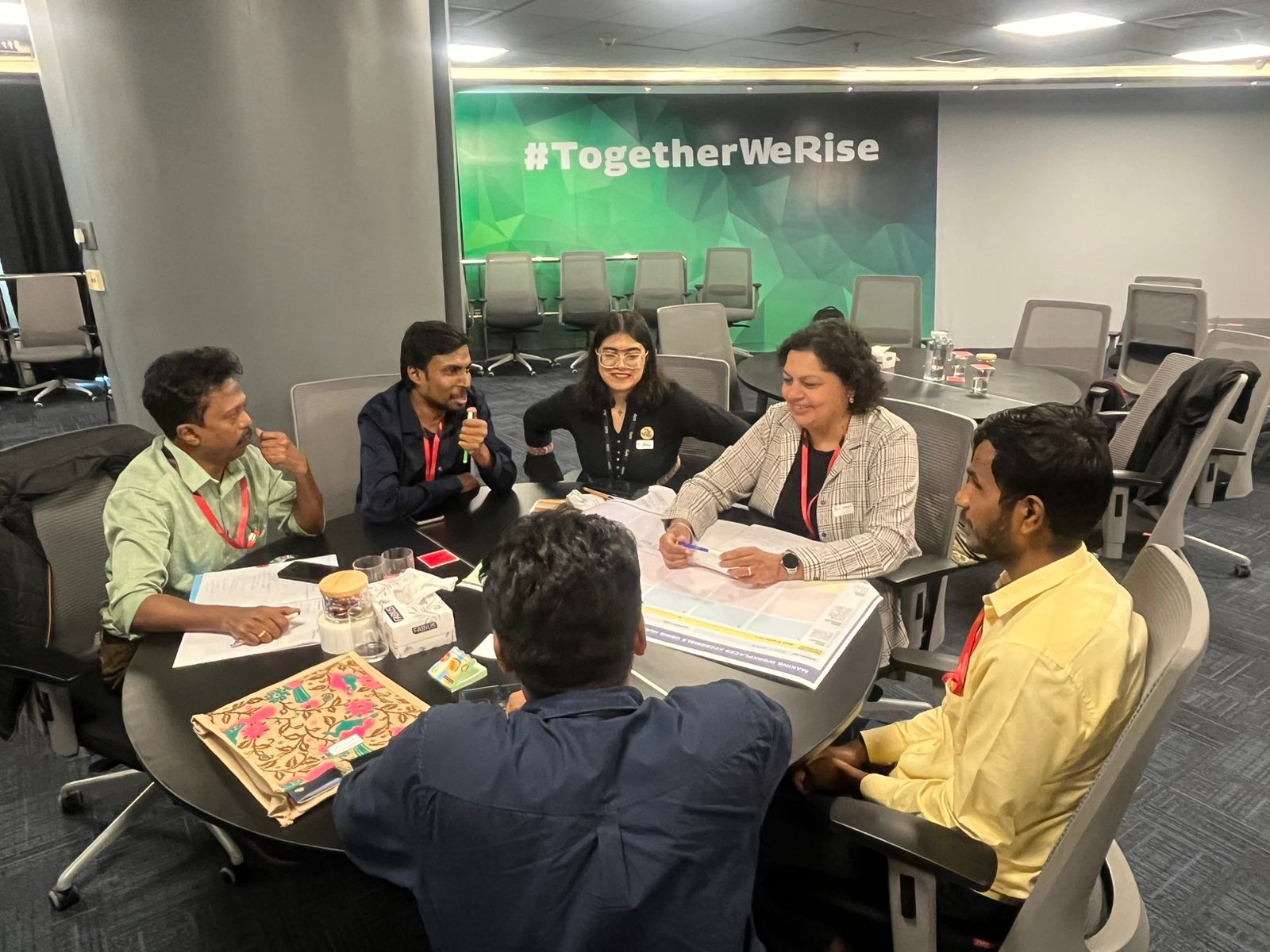
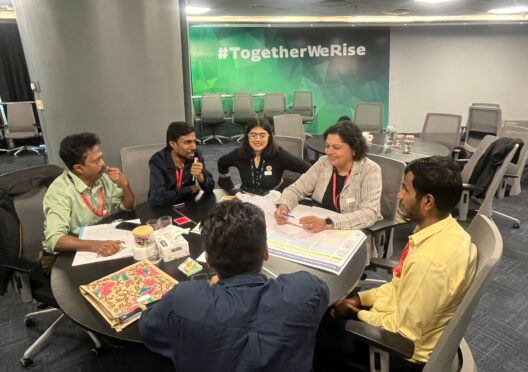
Following the brief sharing from my colleagues, the workshop was rolled out. Over the two days, close to 30 participants including senior HR leaders, DEI professionals, startup founders working on accessibility technologies, civil society representatives, and persons with disabilities worked in mixed teams to map real workplace journeys. These journeys spanned recruitment, commuting, onboarding, and facility usage, all from the perspective of a PwD.
What felt “normal” suddenly became unfamiliar.
A speed breaker that destabilises a wheelchair.
A biometric system that fails to recognise certain bodies.
An onboarding session where slides are never described aloud.
Step by step, the invisible became visible.
One participant reflected, “I have never examined my own assumptions so closely before.
”Another shared, “It is not the lack of ability, it is the lack of tools and environment that disables.
”Someone else said, “I never realised disability and accessibility had so many layers”.
There was no judgement in the room. Only understanding. That was precisely why we were there. The primary premise of organizing the workshop seemed to be fulfilled.
Participants identified physical, digital, and procedural barriers, and then co-designed solutions. Visual journey maps captured both the original and redesigned workflows, documenting barriers alongside proposed fixes. The experiential nature of the process fostered deep empathy and generated tangible outputs.
By “living the end-user’s life,” participants confronted widely held myths, such as accessibility being expensive or relevant only to a few. Case studies from organisations such as Lemon Tree Hotels, SAP, and Microsoft demonstrated that even modest changes can lead to significant impact. Each group presented redesigned workflows, built a business case for accessibility, and committed to concrete next steps.
From Realisation to Hope
The heaviness of realisation slowly transformed into energy. Participants, having explored global examples of organisations that had created accessible systems not with massive budgets, but with intention, inched towards building co-creating solutions.
Soon, the tables filled with sketches:
- Inclusive interview formats
- Accessible digital portals
- Buddy systems
- Flexible performance reviews
- Emergency evacuation plans for everyone
Throughout this process, persons with disabilities were not observers. They were designers, critics, and co-creators.
One overwhelmed participant remarked, “This is the only full day in months when I didn’t open my phone or ChatGPT. I was completely engaged.” A PwD participant added with a smile, “This is one of the first meetings where I’m not explaining my problems, I’m building the solution.”
Voices That Stayed With Us
As the workshop drew to a close, what stayed with us most were the reflections participants carried back with them. One person shared, “I realised that needs and solutions are not the same, we often jump to fixing without truly understanding.” Another said, “From now on, accessibility will not be an add-on for me; it has to be built in from the very beginning.”
There was also a deeper recognition of lived realities, with someone reflecting, “We speak about PwDs in general, but today I understood how different each contextual journey truly is.”
One participant with a disability offered a powerful insight of their own: “Even within our community, inclusion has to be intersectional, we cannot speak only from our own experience.”
And perhaps the most resounding takeaway was this: “The human-centered design framework will stay with me; it has changed how I think about systems, people, and responsibility.”
What Stayed With Me
This was never just a workshop about accessibility.
It was an unmasking of assumptions.
An invitation to listen without the urgency to fix.
A reminder that exclusion may be unintentional, but its impact is never accidental.
Somewhere between the journey maps and the redesigned workflows, between discomfort and discovery, between broken systems and imagined futures, something quietly yet irrevocably shifted.
We did not merely learn how to build inclusive workplaces.
We learned how to question our power, our assumptions, and our comfort.
We learned how to become more inclusive humans.
And perhaps that is where accessibility truly begins.
Share


Related Blogs

Our Partners