

COLOR


SEARCH


23/03/2026
Kumar Mahavir
Opinion
Beyond the Barrier: The Person Behind the Screen
Imagine waking up in a world where the “play” button is a barrier rather than a gateway. You open a video for a work meeting, but there are no captions. You join an online university lecture, but there is no sign language interpreter on the screen. You try to watch a viral news clip, but without audio, the context is lost. For millions of Indians who are persons with hearing impairment, this isn’t a hypothetical scenario—it’s a daily reality. While India is sprinting toward a “Digital India” future, a massive portion of our population is still running into a glass wall. We’ve built the digital highway, but we forgot to put up the signs everyone can read. When we talk about “digital accessibility,” most people think of screen readers for the blind or physical ramps for those with locomotor disabilities. While these are vital, focusing on only one type of access leads to a lopsided digital world where the specific challenges faced by persons with hearing impairment are often “invisible” and frequently ignored.
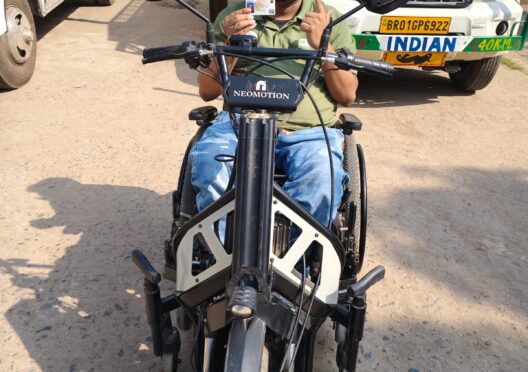
As someone navigating the world with a locomotor disability, I know firsthand that accessibility is rarely about a single fix; it is about a universal design that respects the autonomy of every individual. It is about looking beyond the disability to the person—the professional, the student, the friend—who simply wants to participate without having to ask for permission or a “special” workaround. In education, employment, and even social media, the reliance on audio-heavy content is skyrocketing. From podcasts to uncaptioned reels and “audio-only” verification codes, the digital space is becoming louder, yet quieter for those who cannot hear. It isn’t just an inconvenience; it is a form of exclusion that limits where a person can work, what they can learn, and how they connect. According to the World Health Organization (WHO), over 5% of the world’s population—roughly 430 million people—require rehabilitation to address ‘disabling’ hearing loss. In India, estimates suggest that approximately 6.3% of the population suffers from significant auditory loss, making this a massive demographic being left out of the digital conversation
.
The irony is that, legally, this shouldn’t be happening. India has one of the most progressive laws in the world: the Rights of Persons with Disabilities (RPwD) Act of 2016. This law explicitly states that digital services—both government and private—must be accessible to everyone. To back this up, India even has a specific technical “rulebook” known as IS 17802. This set of standards tells developers exactly what they need to do: provide accurate captions, offer text transcripts, and ensure visual alerts replace audio pings. So, if the law exists and the instructions are clear, why are we still seeing so many “Silent Screens”? To understand this, we have to look past the legal jargon and into the lives of different generations. Take a young college student today. They are “digital natives,” expected to learn through YouTube tutorials and Zoom calls. When these platforms lack real-time captioning, that student isn’t just missing a lecture; they are being told, implicitly, that this space wasn’t built for them. They end up spending hours “hacking” their way through—using third-party apps to transcribe audio or asking friends for notes—just to get the same information their peers get in seconds.
Then, look at the older generation, professionals who have seen the world move from paper to pixels. For them, the digital shift often feels like a door closing. In a workplace that moves at the speed of a WhatsApp voice note or a quick video huddle, the lack of visual communication tools means their expertise is sidelined. This is the “Coping Strategy” tax—the extra mental energy, time, and stress that persons with hearing impairment must spend every single day just to navigate a world that refuses to turn on the captions. True inclusion happens when we stop treating accessibility as an “add-on” for a specific group and start seeing it as a fundamental right that benefits everyone. When a video has captions, it doesn’t just help persons with hearing impairment; it helps the person in a noisy train, the student learning a second language, and the elderly person whose hearing is fading. Research by the 3Play Media state of accessibility report indicates that 80% of people who use captions are not actually hearing impaired; they use them for clarity and focus. This proves that accessible design is simply better design. Digital accessibility is a bridge. On one side, we have the law and the technology. On the other, we have millions of talented, capable individuals—people who are so much more than their physical or sensory limitations—waiting to contribute. It’s time we finally finish building that bridge and ensure that every “play” button is an invitation, not a barrier.
Share


Related Blogs
Our Partners