

COLOR


SEARCH
30/04/2026
Satya Prakash
Access Adda Blog Competition
When a Ramp becomes a right: Rethinking accessibility in everyday India
We talk about accessibility in boardrooms and policy documents. We cite international conventions, budget allocations, and compliance checklists. However, sometimes, accessibility reveals itself in the most unremarkable corner of an ordinary day and that is precisely where its true meaning lives. It’s high time that we move beyond just window dressing and hit the ground
where the work needs to be done.
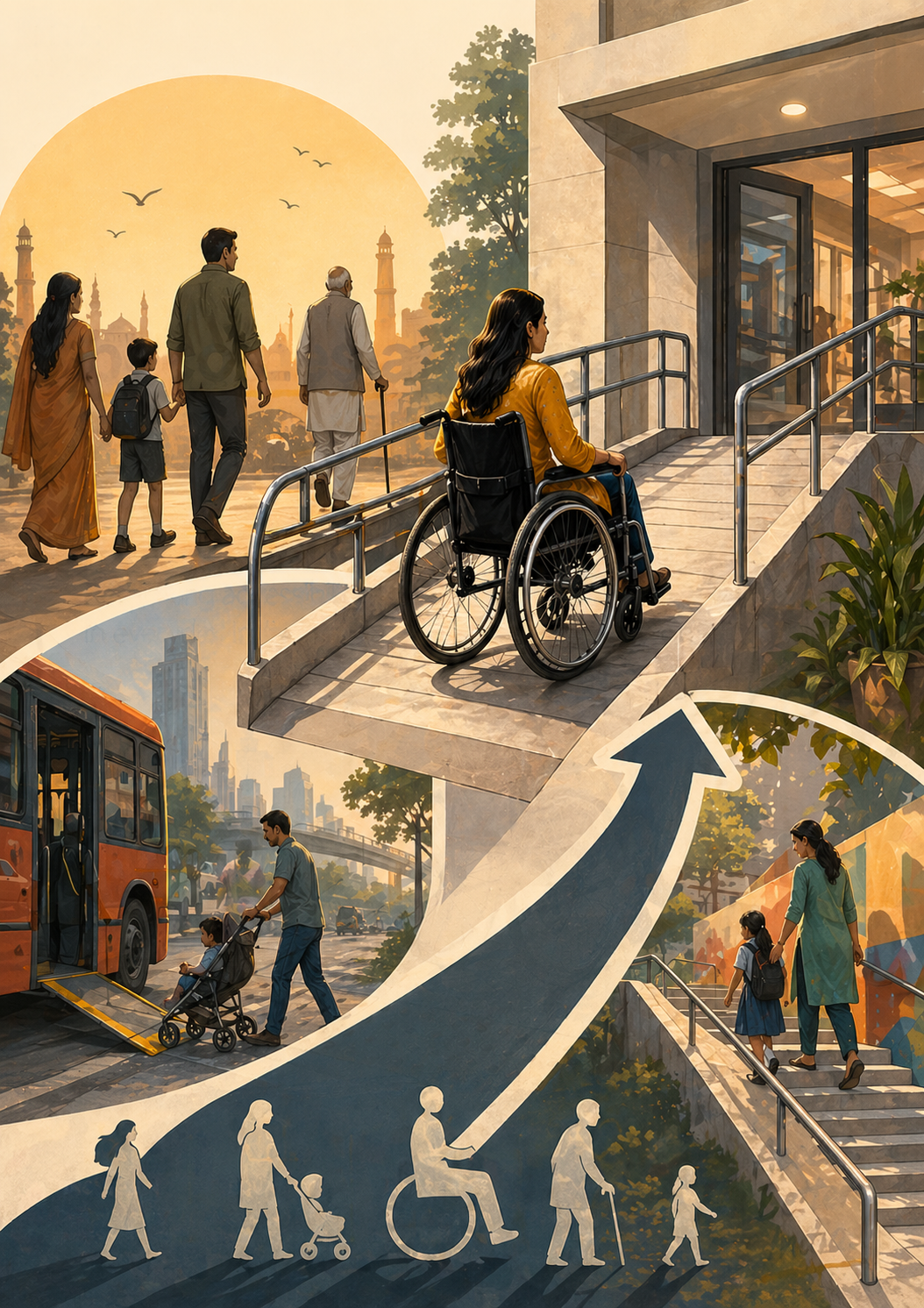
I work with government administration. My days are filled with engaging with bureaucrats, making sense of schemes, and the constant effort to translate policy intent into ground-level reality. And yet, it took a chance encounter at a district office to make me truly understand what accessibility means. A woman had arrived to submit documents for a welfare scheme. She used a wheelchair. The office entrance had three steps, no ramp, no alternative path. Two colleagues lifted her chair, apologetically, mechanically. She smiled through it. But that smile carried the quiet exhaustion of someone who has been “accommodated” her entire life, never truly included.
The most important shift we need to make in policy, in design, in attitude – is to stop treating accessibility as a favour. A ramp is not generosity. A screen reader is not a luxury. An accessible government portal is not going above and beyond. These are rights, and their absence is a failure of the system, not a personal limitation of the individual.
Accessibility is also invisible in ways we rarely discuss. It is the government website that crashes on a low-bandwidth connection in a rural block. It is the gram sabha meeting held without a sign language interpreter. It is the welfare form available only in English in a region where people speak regional dialect.
In Jharkhand, where I work, a significant portion of the population belongs to tribal and rural communities for whom language, geography, and digital literacy are real barriers.
True accessibility here means schemes communicated in local dialects, helplines that actually function, and grievance portals that work on a basic Android phone with 2G connectivity.
But here is what gives me hope: accessibility also lives in small, deliberate human choices. The anganwadi worker who reads out the form to an elderly woman who cannot see. The young district officer who insists that every public event have a designated accessible entry. This is where I see ray of hope. These acts do not make headlines. But they are the architecture of an
inclusive society, built one thoughtful decision at a time.
Accessibility is everyone’s work, not just the architect’s, not just the IT team’s, not just the disability rights activist’s. As citizens, as colleagues, as decision-makers, we can ask one simple question before we build, design, or plan anything: Who is this leaving out?
I am not sure if the ramp outside that district office has still been installed three months after the encounter. However, the episode moved something within me. It made me more conscious and aware citizen who tries to practice accessibility in everyday life. I feel it’s a journey for me and for everyone else.
Share


Related Blogs
Our Partners